Best Collagen Supplements for Men Over 45: Animal-Based vs. Vegan — What Actually Works

21 Best Things to Do in Cozumel (2026 Travel Guide)
June 12, 2026
Vegan Hair Supplements That Actually Work — What to Take, What to Skip, and Why Your Diet Matters More Than the Bottle
June 16, 2026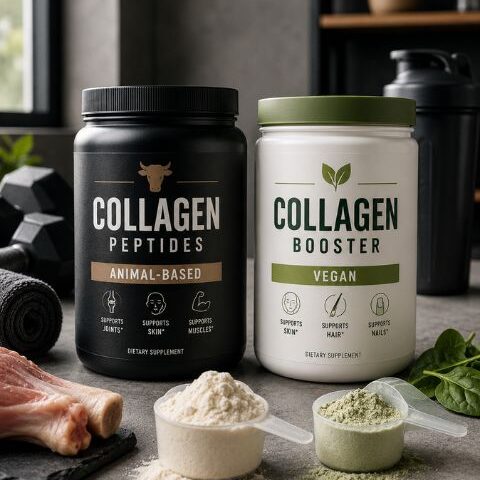
Nobody tells you in your 30s that your body has already started winding down collagen production. By the time you hit 45, you’ve lost roughly a quarter of your skin’s collagen density, your joints feel less forgiving after a tough workout, and recovery takes noticeably longer. Welcome to the club nobody asked to join.
Collagen supplements have exploded in popularity — but walk into any health store and you’re staring down a wall of options: bovine, marine, “vegan collagen,” peptides, capsules, powders. As a man over 45, you need to cut through the noise fast and figure out what actually moves the needle for you specifically.
This article breaks it all down — why collagen declines as you age, how animal-based and vegan options compare, what to actually look for on the label, and the real-talk answers to questions men are asking on Reddit and Quora right now.
Why Collagen Matters More After 45
Collagen is the most abundant protein in the human body — making up about 30% of total protein content. It’s the structural scaffolding for your skin, joints, cartilage, tendons, gut lining, and even blood vessels. Production peaks in your mid-20s, then drops roughly 1–1.5% per year after that.
For men over 45, this means: creaky knees after squats, slower recovery from strength training, thinning skin, and sometimes poor gut health. Testosterone also declines in this window, and since testosterone plays a supporting role in collagen synthesis, the drop compounds the problem.
The good news? Supplementation with hydrolyzed collagen peptides has real, peer-reviewed evidence behind it — especially for joint pain and skin elasticity in the 40–60 age group.
Animal-Based Collagen: The Gold Standard (With Caveats)
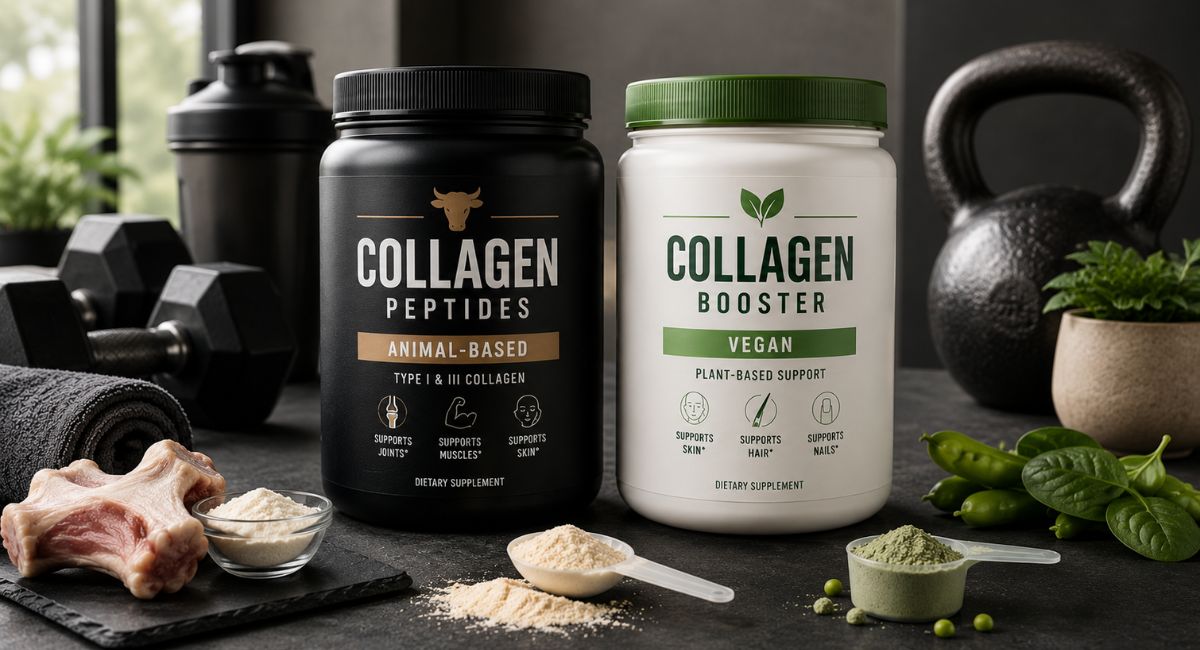
Animal-derived collagen is the only form that contains actual collagen protein. It’s broken down into hydrolyzed peptides — short amino acid chains that your gut can absorb efficiently and your body can use to signal collagen synthesis.
Bovine (Grass-Fed Beef) Collagen
The most common type. Rich in Type I and Type III collagen — the same types that dominate your skin, tendons, ligaments, and muscles. This makes bovine collagen particularly good for men focused on skin health and muscle/joint recovery. Look for “grass-fed, pasture-raised” sourcing, which tends to have a better amino acid profile and lower contamination risk.
Marine Collagen
Sourced from fish skin and scales. Primarily Type I collagen, and it has a smaller molecular size than bovine, meaning it may absorb slightly faster into the bloodstream. If skin elasticity and anti-aging are your primary goals, marine collagen edges out bovine marginally — though practically speaking, the differences are small. It’s also a good option if you avoid red meat.
Chicken Collagen
Mostly Type II collagen, which is the primary form found in cartilage. If your main concern is joint pain — especially knee and hip cartilage wear — chicken-derived collagen (or undenatured Type II collagen, called UC-II) is worth considering specifically for that.
Vegan “Collagen”: What It Actually Is
Here’s where it gets a bit technical — and where a lot of marketing blurs the line. There is no true vegan collagen. Collagen is an animal protein; it cannot be extracted from plants. What’s sold as “vegan collagen” is really one of two things:
1. Collagen boosters / precursors — supplements that contain the raw materials your body uses to make its own collagen: vitamin C, zinc, silica, lysine, proline, and glycine. These are genuinely useful for supporting collagen synthesis, but they’re not a 1:1 replacement for taking exogenous hydrolyzed peptides.
2. Biotech/fermented “vegan collagen” — a newer category where collagen-producing genes are introduced into yeast or bacteria to produce collagen-like proteins. These are still largely in early development and not yet widely available in consumer supplements as of 2026.
Bottom line: if you’re plant-based, a quality collagen booster stack (high-dose vitamin C + silica + zinc + glycine-rich foods) is your best move. It won’t replicate what bovine peptides do, but it’s not nothing either — especially if your diet is already clean and protein-dense.
Head-to-Head: Animal-Based vs. Vegan Collagen
| Factor | Animal-Based (Bovine/Marine) | Vegan Collagen Booster |
|---|---|---|
| Actual collagen content | Yes — hydrolyzed peptides | No — supports your body’s own production |
| Bioavailability | High (especially marine) | Indirect — depends on overall health |
| Joint support | Strong evidence (Type I, II, III) | Modest evidence via precursors |
| Skin & elasticity | Well-studied, consistent results | Vitamin C helps; less direct |
| Muscle recovery | Good — amino acid profile helps | Depends on total protein intake |
| Ethical/dietary fit | Not vegan/vegetarian | Vegan-friendly ✓ |
| Cost | $30–$60/month quality range | $20–$45/month |
| Taste/mixing | Mostly unflavored, mixes well | Varies widely |
What to Look for When Buying (Regardless of Type)
The supplement industry is still loosely regulated, so label-reading matters. For animal-based collagen, look for: hydrolyzed collagen peptides (not gelatin), third-party testing (NSF, Informed Sport, or Labdoor), minimal additives, and clearly stated collagen type. For vegan boosters, check that vitamin C is at least 500–1000mg, and that silica and zinc are both included.
Dosage matters too. Most clinical studies showing results for joint and skin health used 10–15g of collagen peptides per day. Anything under 5g is unlikely to move the needle meaningfully.