How Email Marketing Fuels Your Overall Inbound Strategy

Vegan Hair Supplements That Actually Work — What to Take, What to Skip, and Why Your Diet Matters More Than the Bottle
June 16, 2026
Best Food Options for Party Catering in Melbourne
June 19, 2026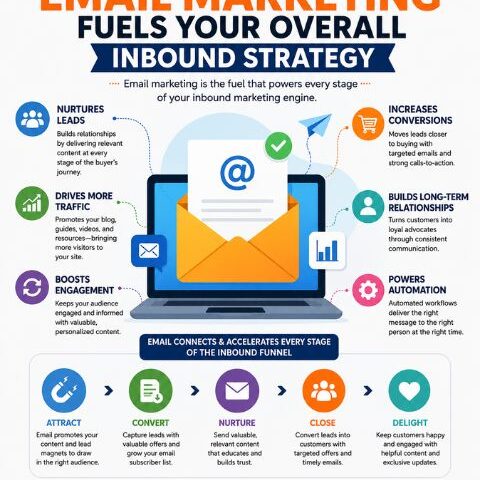

Ask most marketers where email fits in their strategy and you’ll get one of two answers: either it’s a dedicated “email marketing“ channel siloed from their broader content work, or it’s an afterthought — the newsletter they send when they remember to. Both are missed opportunities.
Email marketing, done right, is the engine that turns every other inbound investment into compounding returns. It takes the traffic your content earns, the leads your SEO attracts, and the brand awareness your social media builds — and converts that attention into lasting relationships that generate revenue long after the click.
In this guide, we’ll break down exactly how email marketing fuels your inbound strategy at every stage, with tactics you can implement immediately and metrics that prove the value to stakeholders.
Email marketing delivers an average return of $36 for every $1 spent — the highest ROI of any digital marketing channel. Yet only 35% of marketers say their email strategy is tightly integrated with their broader inbound program.
- The Inbound Flywheel, Quickly Refreshed
- 6 Ways Email Powers Every Stage of Inbound
- The Content–Email Feedback Loop
- Metrics That Prove Email’s Inbound Contribution
- Your Email–Inbound Integration Checklist
- FAQ
The Inbound Flywheel, Quickly Refreshed
Inbound marketing is built on a simple idea: attract the right people to you, help them solve real problems, and earn their business through value rather than interruption. HubSpot’s flywheel model organizes this into three stages — Attract, Engage, Delight — and the goal is to keep it spinning faster over time, with each customer creating momentum for the next.
| Stage | Goal | Traditional Channels | Email’s Role |
|---|---|---|---|
| Attract | Draw the right strangers to your brand | SEO, blog, social media, paid ads | Capture email, amplify content, drive return visits |
| Engage | Turn visitors into leads and leads into customers | Landing pages, offers, CRM | Nurture sequences, behavioral triggers, personalization |
| Delight | Turn customers into advocates | Support, communities, loyalty programs | Onboarding series, loyalty emails, re-engagement |
Email touches all three stages. That’s what makes it different from almost every other inbound channel — and why neglecting its integration is one of the most common and costly mistakes in B2B and B2C marketing alike.
6 Ways Email Marketing Powers Every Stage of Inbound
1. Converting Casual Readers Into a Captive Audience (Attract → Engage)
The first and most fundamental job of email in your inbound strategy is to capture the attention you’ve already earned. Organic search and content marketing bring visitors to your site — but most of them will never come back unless you give them a reason.
A well-placed opt-in offer — a content upgrade, a resource download, a free mini-course — converts single visits into ongoing relationships. This is the lead magnet moment, and it’s where email begins paying dividends on your SEO investment.
Content upgrades outperform generic newsletter popups by 3–5×. Instead of a site-wide “subscribe to our newsletter” popup, offer a bonus resource that’s directly related to the article the reader is on — a checklist, a template, a deeper dive. This raises opt-in rates because the value exchange is immediate and contextually relevant.
The key principle here is value specificity. The more directly the opt-in offer solves the reader’s immediate problem, the higher the conversion rate — and the more motivated the new subscriber will be to engage with your future emails.
2. Lead Nurturing That Closes the Gap Between Interest and Intent
Most inbound leads aren’t ready to buy when they first arrive. Research from Marketo suggests that 96% of website visitors are not ready to make a purchase on their first visit. Without a nurturing system, you’re pouring resources into top-of-funnel content and losing almost all of it at the conversion stage.
Email fills that gap with automated nurture sequences that guide leads from awareness to consideration to decision — at their own pace, triggered by their own behavior:
- Welcome sequences that orient new subscribers to your brand, set expectations, and deliver immediate value
- Educational drips tied to the topic the lead opted in for
- Behavior-triggered emails sent when a lead visits a pricing page, watches a demo video, or downloads a product comparison guide
- Sales handoff emails that fire when a lead’s engagement score hits a threshold, flagging them for a rep to follow up
“Nurtured leads make 47% larger purchases than non-nurtured leads.” — Annuitas Group
The sophistication of your nurture sequences should match your sales cycle length. A B2B SaaS company with a 90-day sales cycle needs a very different email program than a direct-to-consumer brand with a two-day purchase window.
3. Personalization at Scale: Segmentation as a Superpower
Inbound marketing’s promise is relevance — the right message to the right person at the right time. But content alone can’t deliver that across a diverse audience. Email segmentation is what makes mass personalization possible.
By segmenting your list based on behavior, demographics, lifecycle stage, and engagement level, you can send emails that feel individually crafted rather than mass-broadcast. The results are dramatic:
760%Increase in email revenue from segmented campaigns compared to one-size-fits-all sends, according to Campaign Monitor research.
Effective segmentation criteria for inbound-driven lists include:
| Segment Type | Criteria | Email Use Case |
|---|---|---|
| Content interest | Which lead magnet / blog category they came from | Send content on that specific topic cluster |
| Funnel stage | New subscriber vs. active engager vs. sales-ready | Adjust content depth and CTA type |
| Engagement level | Open/click frequency over the last 90 days | Win-back sequences for disengaged, reward sequences for loyals |
| Customer status | Lead vs. customer vs. churned customer | Upsell, onboarding, or re-acquisition flows |
4. Re-Engaging Cold Leads Without Paid Spend
One of email’s most underappreciated inbound functions is lead resurrection. Your CRM almost certainly contains a graveyard of leads who expressed real interest at some point — attended a webinar, downloaded a guide, requested a demo — but went cold before converting.
These aren’t dead leads. They’re dormant assets, and email is the only channel that lets you reach them directly, at near-zero marginal cost, without paid media.
A well-designed re-engagement sequence typically looks like this:
- Email 1 (Day 0): A pattern-interrupt subject line (“We miss you” is overdone — try something specific to what they originally engaged with)
- Email 2 (Day 4): A new piece of content directly relevant to their original interest, signaling you’ve got more value to offer
- Email 3 (Day 9): A soft offer — a free consultation, an updated resource, or a relevant case study
- Email 4 (Day 14): A sunset email — clear, honest, and permission-affirming (“Should I keep sending you emails?”)
Re-engagement campaigns consistently see open rates 2–3× higher than standard campaigns because the audience is primed by the novelty of contact after a gap. Even if only 15% re-engage, that’s free pipeline recovery from a list you’ve already built.
5. Amplifying Content Reach and Driving SEO Traffic
Here’s a connection that many marketers miss: email doesn’t just benefit from your inbound content — it actively fuels your content’s SEO performance.
When you send an email featuring a new blog post, two things happen beyond the immediate click. First, engaged subscribers who find the content genuinely useful share it — generating organic backlinks that build domain authority. Second, the traffic signal sent by direct clicks (users arriving with intent, spending time on-page, reading deeply) is a positive behavioral signal that can reinforce rankings over time.
This creates a virtuous cycle:
- Your SEO brings readers → some become email subscribers
- Your email promotes new content → sends traffic and social shares
- Traffic and shares generate backlinks → improve rankings
- Better rankings bring more readers → grows the list further
Treating your email list as a content distribution amplifier — not just a lead generation tool — is one of the highest-leverage moves in inbound marketing.
6. Turning Customers Into Advocates (Closing the Delight Loop)
The inbound flywheel doesn’t stop at the sale. The delight stage — turning customers into promoters — is what separates a scalable inbound program from one that’s always chasing new top-of-funnel volume.
Email is the primary channel for post-purchase delight:
- Onboarding sequences that help new customers get value fast, reducing churn and building habit
- Loyalty and VIP programs communicated via email, creating emotional investment in the brand
- Referral campaign emails that turn happy customers into active recruiters
- Milestone emails (1-year anniversary, 100th order, usage milestones) that celebrate the relationship and invite reviews
Customer advocacy emails cost a fraction of acquisition campaigns — and referred customers typically have higher lifetime value and lower churn rates than leads acquired through paid channels.
The Content–Email Feedback Loop That Compounds Over Time
Perhaps the most powerful argument for tightly integrating email with your inbound strategy is what happens when the two build on each other over months and years.
Your email list gives you a direct line to your most engaged audience. This is a research asset as much as a marketing asset. By tracking which emails generate the most clicks, which subject lines spark the most opens, and which calls-to-action convert — you generate continuous, real-time data about what your audience actually cares about.
That data should directly inform your content calendar. If a mid-funnel email about pricing strategy consistently outperforms emails about feature announcements, that’s a signal that your audience is further down the consideration stage than your content calendar reflects — and that you should create more decision-stage content.
Most teams run their email program and their content strategy in separate tools with separate owners. The insight from email engagement never flows back into the editorial calendar, and the content team never knows which blog posts are actually converting subscribers. Break down this silo — even a monthly 30-minute sync between the two teams dramatically improves output quality.
Metrics That Prove Email’s Inbound Contribution
To earn investment in email as an inbound driver (rather than a cost center), you need to measure it differently. Standard email metrics — open rates, click rates — don’t tell the full story. Here’s how to track email’s contribution to inbound outcomes:
| Metric | What It Measures | Inbound Relevance |
|---|---|---|
| List growth rate | Monthly net new subscribers as % of total list | Reflects quality of lead capture — inbound’s top-of-funnel health |
| Email-sourced MQLs | Leads that reached MQL status via email engagement | Directly links email to pipeline generation |
| Content click-through rate | Clicks on blog/content links in emails | Measures email’s amplification of content assets |
| Nurture-to-opportunity rate | % of nurtured leads that become sales opportunities | Proves email’s role in moving leads through the funnel |
| Email-attributed revenue | Closed-won deals where email was last or first touch | Demonstrates email’s direct commercial contribution |
| Customer email engagement score | Post-purchase email open/click activity | Predictor of retention, upsell, and advocacy |
Your Email–Inbound Integration Checklist
If you’re starting from scratch or auditing your existing program, use this checklist to identify gaps between your email and inbound efforts:
- Every major blog post or content asset has a corresponding lead magnet (content upgrade or resource download)
- New subscribers receive a welcome sequence (minimum 3 emails) that delivers value before asking for anything
- Email list is segmented by at least: content interest topic, lifecycle stage, and engagement level
- Behavior-triggered emails are set up for high-intent actions (pricing page visit, demo view, free trial start)
- A re-engagement sequence exists for subscribers inactive for 90+ days
- Email send schedule includes promotion of new blog content within 48 hours of publication
- Email performance data is reviewed monthly by both the email and content teams
- Post-purchase onboarding sequence exists for new customers (minimum 5 emails over 30 days)
- At least one referral or advocacy email is sent to customers at the 60- or 90-day mark
- Email-sourced MQLs and revenue are tracked in your CRM with proper attribution
Frequently Asked Questions
The Bottom Line
Email marketing isn’t competing with your inbound strategy — it’s completing it. It takes the attention your content earns, the leads your SEO attracts, and the trust your brand builds over time, and gives all of it somewhere to go. It nurtures leads who aren’t ready to buy, reactivates leads who’ve gone cold, amplifies the reach of every piece of content you publish, and closes the loop by turning customers into advocates who feed the flywheel.
The teams that see the highest inbound ROI aren’t the ones with the best content, the best SEO, or the best email program in isolation. They’re the ones who’ve built the connective tissue between all three — and let each channel make the others more powerful.