Vegan Hair Supplements That Actually Work — What to Take, What to Skip, and Why Your Diet Matters More Than the Bottle

Best Collagen Supplements for Men Over 45: Animal-Based vs. Vegan — What Actually Works
June 16, 2026
How Email Marketing Fuels Your Overall Inbound Strategy
June 18, 2026
If you’ve gone plant-based and noticed your hair thinning, shedding more than usual, or just looking… dull — you’re not imagining it, and you’re not alone. It’s one of the most common concerns people bring up after switching to a vegan diet, and there’s a real physiological reason it happens.
The good news is that the vegan hair supplement market has genuinely improved. The bad news is it’s also flooded with overpriced biotin gummies that will do almost nothing for you unless you’re already deficient. This article cuts through the noise — what actually depletes on a plant-based diet, which nutrients reverse it, and how to read a supplement label like someone who did their homework.
Why Vegan Diets Can Affect Hair Health
Hair follicles are metabolically demanding. They’re among the fastest-dividing cells in the body, which means they need a near-constant supply of micronutrients to function well. When your diet shifts — even toward something healthier overall — gaps in specific nutrients can show up in your hair first.
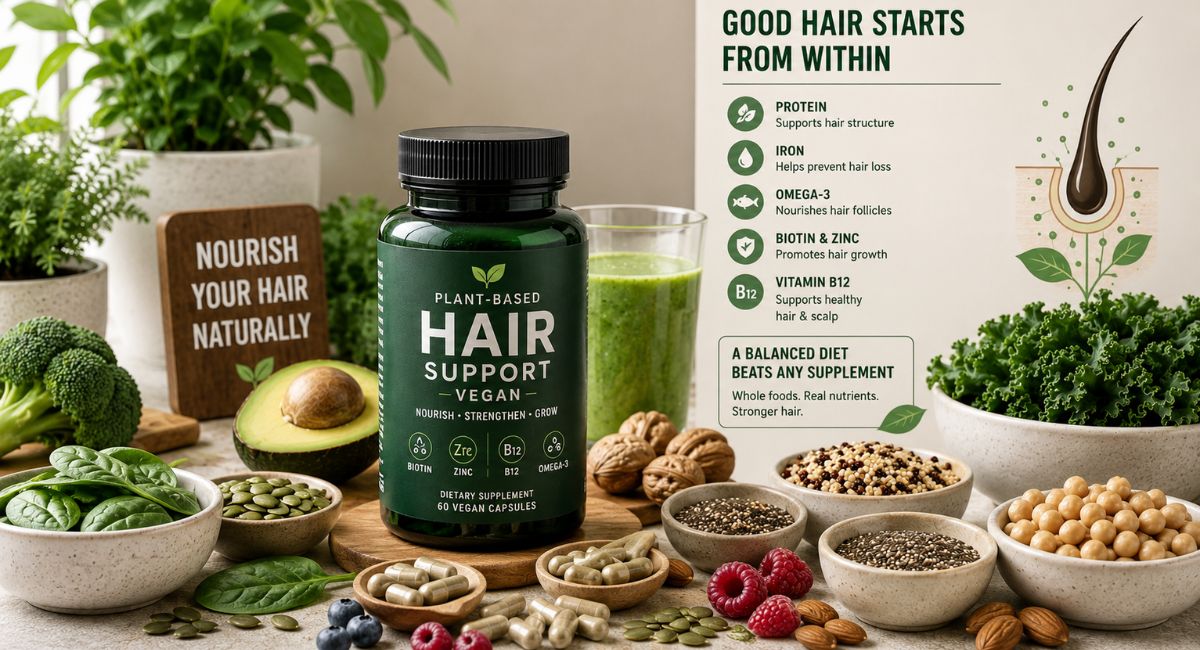
Several key nutrients for hair health are either absent from plants, poorly absorbed from plant sources, or require significantly higher intake to compensate. The most impactful ones:
Iron (Non-Heme)
Plant-based iron is absorbed at roughly 2–20% efficiency vs. 15–35% for heme iron from meat. Iron-deficiency is the single most common nutritional cause of hair shedding in women — and it’s widespread in vegans, especially premenopausal women.
Vitamin B12
Found almost exclusively in animal products. B12 deficiency disrupts red blood cell production, reducing oxygen delivery to follicles. Low B12 → poor scalp circulation → slower growth cycles.
Zinc
Plants contain zinc, but also phytates — compounds that block absorption. Vegans often have 35–45% lower zinc status than omnivores at equivalent dietary intake. Zinc is critical for follicle repair and oil gland function.
Vitamin D3
Most D3 in supplements is derived from lanolin (sheep’s wool) — not vegan. Lichen-derived D3 is the vegan exception. Low vitamin D is strongly linked to telogen effluvium (diffuse hair shedding).
Omega-3 (DHA/EPA)
ALA from flaxseed converts inefficiently to DHA/EPA — the active forms that reduce scalp inflammation and support follicle health. Algae-based omega-3 is the vegan fix here.
Protein / Amino Acids
Hair is ~95% keratin, a protein. Inadequate total protein on a vegan diet — or missing key amino acids like lysine — can directly slow growth or increase shedding. This is often overlooked.
What “Vegan” Actually Means on a Hair Supplement Label
This matters more than most people realize. Plenty of hair supplements marketed to a health-conscious audience still contain hidden animal-derived ingredients:
Gelatin capsules — made from animal bones and skin. Look for “vegetable capsule,” “HPMC capsule,” or “vegan capsule” on the label. Keratin — the protein in most “hair keratin” supplements is hydrolyzed from animal hooves, horns, and feathers. There are plant-derived alternatives (from wheat), but they’re uncommon and less studied. Vitamin D3 from lanolin — the default in most supplements. Look specifically for “D3 from lichen” if this matters to you. Biotin from egg yolk — rare in modern supplements, but worth checking.
Third-party vegan certifications (Vegan Society, Certified Vegan by Vegan Action) are the most reliable signals, though not all quality vegan products bother to pursue them.
The Biotin Question (Let’s Put This to Rest)
Biotin is the darling of the hair supplement world. Gummies, capsules, serums — biotin is everywhere. Here’s the thing: biotin deficiency is actually rare. Your gut bacteria produce some biotin endogenously, it’s found in many plant foods (nuts, seeds, legumes, sweet potato), and deficiency severe enough to cause hair loss is genuinely uncommon.
The research on biotin supplementation for people who are not deficient is weak. Most of the dramatic “before and after” photos circulating online are likely explained by other concurrent changes (diet, stress reduction, other nutrients). Biotin is not harmful in the doses typically found in supplements, but if you’re expecting it to be the key — it probably isn’t.
Ingredients That Actually Have Evidence Behind Them
| Ingredient | What It Does for Hair | Vegan Source | Evidence Level |
|---|---|---|---|
| Iron (ferrous bisglycinate) | Prevents telogen effluvium caused by iron deficiency; feeds follicle oxygen supply | Chelated form — plant-derived | ⭐⭐⭐⭐⭐ Strong |
| Vitamin D3 (lichen) | Supports hair cycle regulation; deficiency linked to alopecia | Lichen (e.g., Vitashine) | ⭐⭐⭐⭐ Good |
| Zinc (zinc picolinate) | Follicle repair, sebum regulation, keratin production | Chelated form — vegan | ⭐⭐⭐⭐ Good |
| B12 (methylcobalamin) | Red blood cell health, oxygenation of scalp | Fermented / synthesized — vegan | ⭐⭐⭐⭐ Good |
| Algae Omega-3 (DHA/EPA) | Reduces scalp inflammation; supports follicle density | Microalgae (e.g., life’sDHA) | ⭐⭐⭐ Moderate |
| Silica (bamboo extract) | Structural support for hair shaft; improves tensile strength | Bamboo, horsetail extract | ⭐⭐⭐ Moderate |
| Biotin | Essential cofactor for keratin production | Fermented — vegan | ⭐⭐ Weak (unless deficient) |
| Saw Palmetto | May inhibit DHT (androgen-related hair loss) — particularly useful for women with hormonal shedding | Plant extract — vegan | ⭐⭐ Emerging |
What to Realistically Expect (And When)
Hair grows slowly — about half an inch per month. Any supplement-driven improvement in the growth cycle takes time to become visible. Here’s a rough honest timeline:
Within the first 4–6 weeks: you might notice less shedding if a deficiency was driving telogen effluvium. This is often the first measurable change. By 3 months: new growth becomes visible at the hairline and part. By 6 months: meaningful improvement in thickness and density if the root cause was nutritional. No supplement will regrow hair lost to genetic pattern baldness — and none should claim to.
“I went vegan at 28 and around month 4 my hair started coming out in chunks in the shower. I panicked and bought every biotin gummy I could find. What actually helped was getting my ferritin tested — it was at 9. Once I addressed that with iron supplements, things started turning around within 2 months.”
— Reddit, r/veganfitness
“Tried three different ‘vegan hair growth’ supplements. The only one that made a real difference contained D3 from lichen, zinc, and B12. The ones that were basically just biotin did nothing.”
— Quora, “Do vegan hair supplements actually work?”